In the Footsteps of PFC Santos Ramos Gomez
An Extraordinary Journey Through the Remagen Bridgehead – 22 September 2026
On 22 September 2026, I had the privilege of experiencing a day that will remain in my memory for a very long time. Together with Diane Owens, the granddaughter of American soldier PFC Santos Ramos Gomez, I embarked on a journey through the former Remagen bridgehead, retracing the footsteps of her grandfather. In March 1945, he had served with G Company, 2nd Battalion, 39th Infantry Regiment, 9th U.S. Infantry Division, and had taken part in the fighting east of the Rhine. On 14 March 1945, he was wounded during the heavy fighting in the Kalenborn area. After extensive research into war diaries, combat reports, maps, and other contemporary records, I had attempted to reconstruct his movements as accurately as possible. Now, together, we wanted to visit the places where he had fought more than 80 years ago.
Our day began in Erpel, where Diane greeted us warmly. I was accompanied by my friend Jürgen, a former colonel and career officer in the German Bundeswehr. Diane was accompanied by Gene Carbone and Udo Bickers, both longtime friends of her family. Diane had known Gene since their university days, while her friendship with Udo and his family developed through their children, who attended boarding school together in the United States. Udo drove us between the various locations throughout the day, and both he and Gene showed great interest in the military-historical background of our journey.
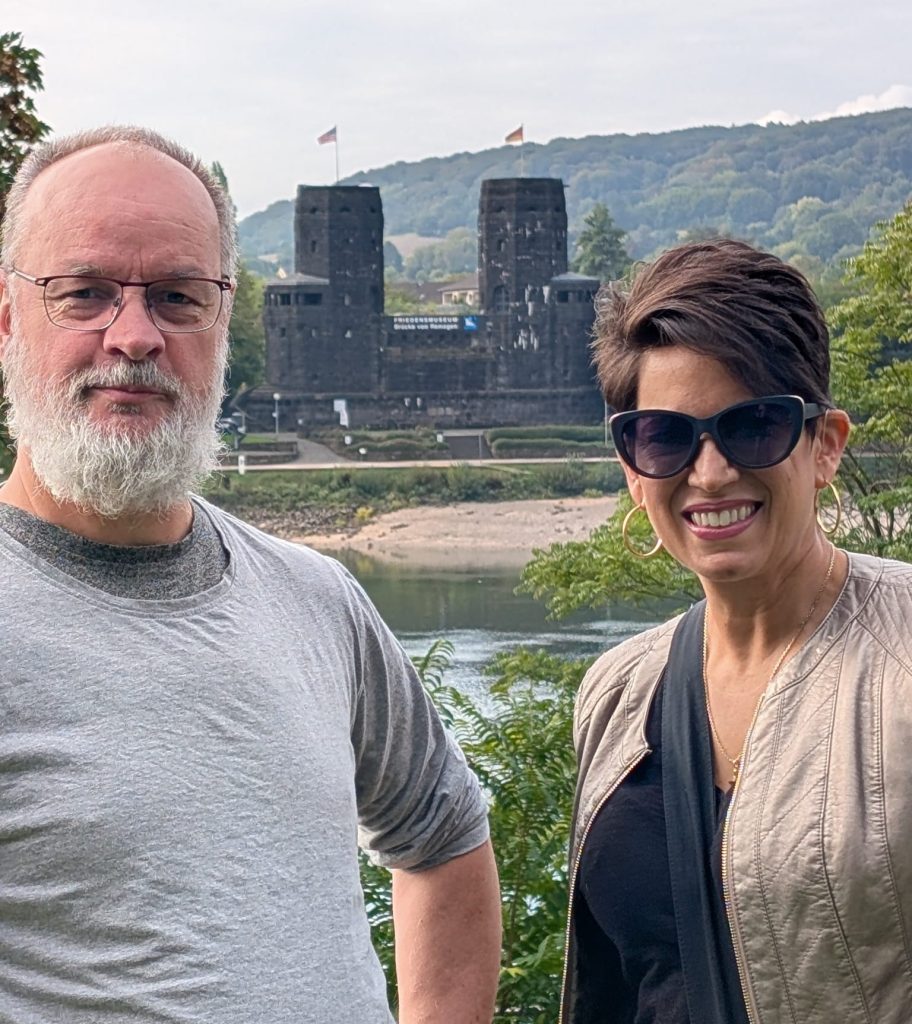
Diane traveled from Connecticut, USA, to learn under what circumstances her grandfather had been wounded in March 1945 in the Remagen bridgehead.
From our very first meeting, it was clear how much this day meant to Diane. She could hardly believe that she was finally able to walk in her grandfather’s footsteps. More than 80 years after the fighting along the Rhine, she was now standing in the very landscape where he had served as an American infantryman in March 1945. What had initially been a military-historical research project for me took on an entirely different meaning through her presence and personal memories.
To understand the journey that brought Santos Ramos Gomez to Remagen, it is worth taking a brief look at the history of his regiment. The 39th Infantry Regiment landed near Algiers in North Africa on 8 November 1942 and subsequently took part in the fighting in Tunisia and Sicily. After being transferred to England, the regiment landed at Utah Beach in Normandy on 10 June 1944. From there, its combat route led across the Cotentin Peninsula, through Cherbourg, France, and Belgium, and eventually into Germany. In the autumn of 1944, the regiment fought along the Westwall and in the Hürtgen Forest before becoming involved in heavy fighting during the German Ardennes Offensive.
One particularly noteworthy engagement involving G Company, to which Santos belonged, is recorded from this period. On 22 December 1944, German forces penetrated American positions in the Rohren area. F and G Companies succeeded in closing the resulting gap and halting the German advance. The regimental history describes these engagements as part of the heavy German attacks in the Monschau–Elsenborn sector. However, Santos’s personal participation in this particular engagement cannot be established solely from his assignment to the company.
Diane told me that her grandfather was originally from Puerto Rico and had lived in New York for seven years before entering military service. The cold winter in Germany had remained particularly vivid in his memory. Even many years later, he repeatedly spoke about his experiences during the Ardennes Offensive and the bitter cold.
We first visited the surviving remains of the Ludendorff Bridge on the eastern bank of the Rhine, followed by the railway tunnel at Erpel. On 10 March 1945, the 39th Infantry Regiment had crossed the Rhine. By that time, the bridge was already damaged and under German artillery fire. Troops, vehicles, and supplies had to be moved across this single narrow crossing while German artillery and aircraft continued their attempts to destroy it. Nevertheless, by evening, the entire regiment had succeeded in reaching the eastern bank. The soldiers then continued through Unkel and Scheuren toward their assembly area near Bruchhausen.
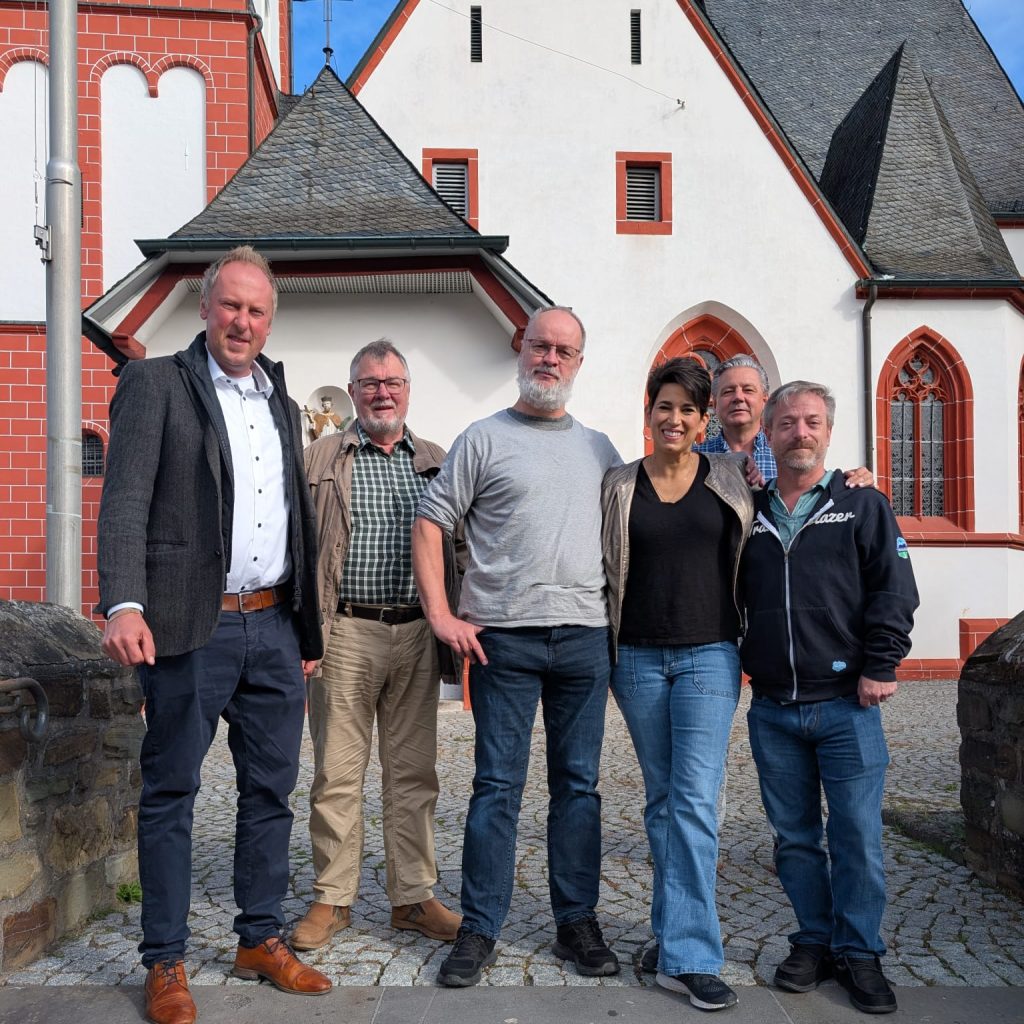
Our Welcome in Bruchhausen – From left: current mayor Stefan Heinrichs, former mayor Adalbert Fuchs, Ralf Anton Schäfer, and Diane Owens. Standing in the background next to Diane is Udo Bickers, with Gene Carbone to her right.
From Erpel, we drove to Bruchhausen, where we were welcomed by the incumbent mayor, Stefan Heinrichs, and former mayor Adalbert Fuchs. Both had kindly agreed to meet us during our visit. Together, we explored the history of the village and the heavy fighting that had taken place in and around Bruchhausen in March 1945. I had also brought several items of ordnance from my own collection, including a German stick grenade and rifle grenades, which I used to explain the weapons employed at the time and their effects. While I was presenting the stick grenade, Diane shared a remarkable story from her grandfather’s wartime experiences.
Santos had been in a foxhole with several fellow soldiers. Before the grenade landed in their position, he had been praying. When the grenade exploded, his friends were killed, while Santos himself survived completely unscathed. For him, this was not simply a matter of chance. He believed that the Blessed Mother had protected him. In gratitude, he made a promise that if he survived the war and returned home safely, he would go to church on his knees. He survived the war and fulfilled his promise. Where and when this incident occurred is no longer known. Nevertheless, the story was a striking example of how deeply individual wartime experiences could remain with a person long after returning home.
During our stay in Bruchhausen, one of the most memorable moments of our day took place. I presented Diane with the complete military-historical study I had prepared on her grandfather’s combat route. Drawing on surviving war diaries, combat reports, and maps, I had attempted to reconstruct his movements from the Rhine crossing to his wounding on 14 March 1945 as accurately as possible. Diane had not expected such a gift at all. She was visibly overwhelmed and close to tears. While we were still together, she sent photographs and messages about the work to her mother and father in Connecticut, where it was only six o’clock in the morning. For me, this was a particularly special moment. After spending so much time studying the historical records, I was now able to give my work a deeply personal meaning. Through Diane, the names, unit designations, and coordinates became the story of a man whom she had known personally and with whom she had shared a close bond.
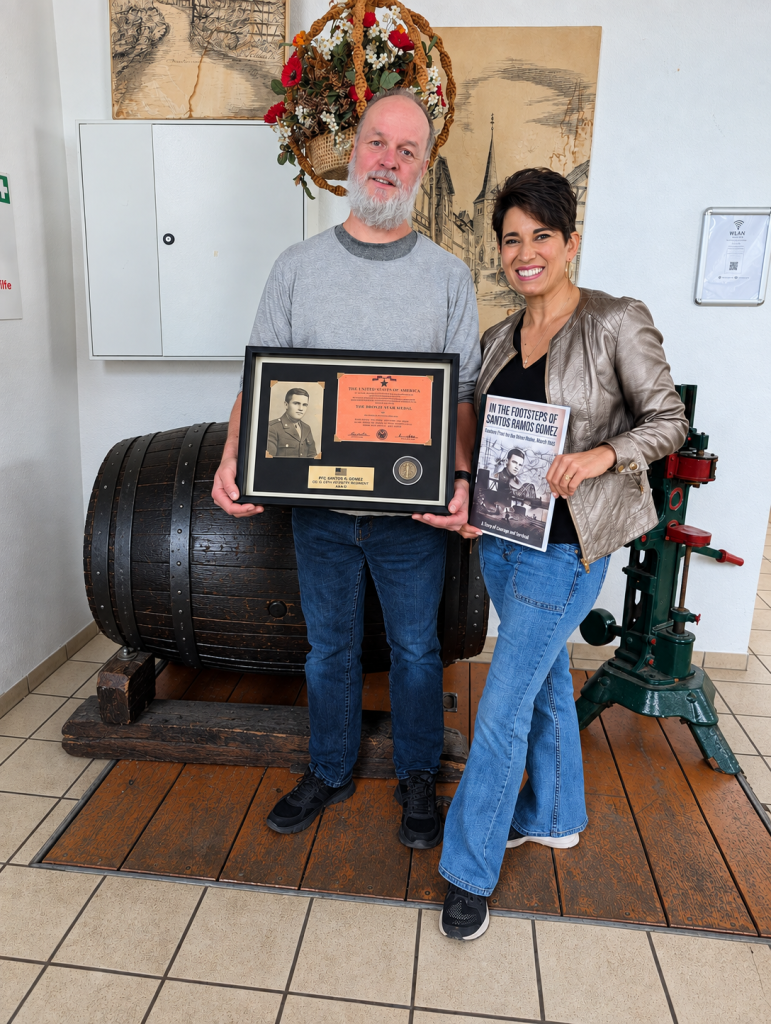
After exchanging some very special gifts. The shadow box will be a treasured addition to my collection.
Shortly afterward, Diane surprised me with an extraordinary gift of her own. She presented me with a large shadow box, approximately 50 × 30 centimetres, containing a photograph of her grandfather, an American silver half-dollar dated 1944, and the certificate accompanying his Bronze Star Medal. I had expected this no more than she had expected my work. This keepsake means an enormous amount to me, because it is not simply a thank-you for my research. It is also a piece of her family history that she has entrusted to me. Santos was also a recipient of the Purple Heart because he had been wounded twice during the war. The Oak Leaf Cluster on his Purple Heart signifies an additional award. The date and location of his first wounding are not yet known. The story surrounding one of those wound notifications is remarkable.
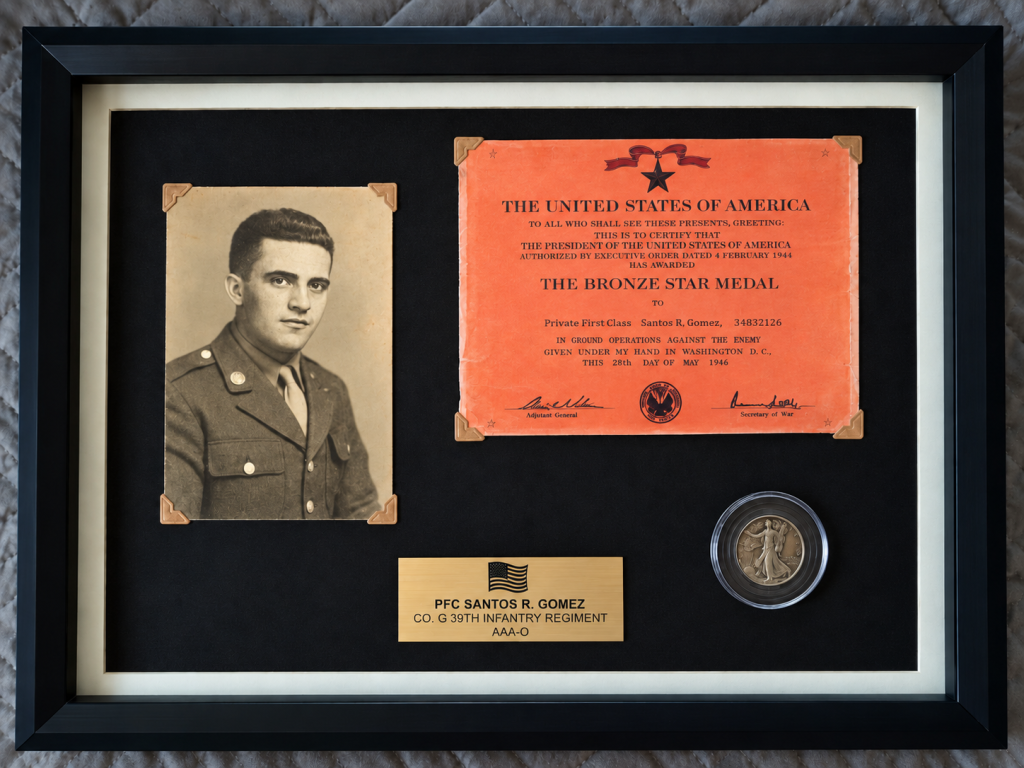
Santos’s wife, Rose, was living in New York with their daughter, Diane’s mother. Rose understood English and should have been the person to receive the military correspondence. Instead, the Army mistakenly sent the notification to Santos’s mother, Diane’s great-grandmother, who could neither read nor speak English. She misunderstood the notice and believed that Santos had been killed in action. The family therefore began a full period of mourning, including el novenario, the novena. For nine days, the family mourned, wore black, and did not leave the house. It was only later, through an exchange of letters with Rose in New York, that Santos’s mother learned the truth. The notification had concerned a wound, not his death. Santos was alive.
Throughout our journey, Diane continued to share memories of her grandfather. She described him as a man who always smiled and never lost his joy in life. Even in a photograph showing him at an advanced age, that smile is still clearly visible. His hair had turned grey, but he was unmistakably the same man.
Santos also played an important role in Diane’s own life and served as a witness at her wedding. His death later became connected with another important moment in the family’s history. On 7 February 2010, Diane’s older son Justy was baptized. Santos Ramos Gomez died on that same day. Alexander Santos, the son who carries his great-grandfather’s name, was born 2012, two years after Santos had passed away. Diane gave him the name Santos in memory of the grandfather who had meant so much to her.
Today, this connection between the generations continues in another way. Alex lives with neurofibromatosis type 1, and Diane has devoted considerable time and energy to raising awareness and funds connected with the condition. During her visit to Germany, she was also preparing for a charity run in Berlin. In this way, her journey carried two very personal meanings: retracing the footsteps of the grandfather whose name her son now carries, while at the same time undertaking another challenge in support of her own child.
These personal stories added a dimension to my military-historical research that could never have been recovered from official records alone. The surviving war diaries tell us where the regiment fought, which objectives it was ordered to take, and what losses it suffered. They cannot tell us about a man who believed the Blessed Mother had saved his life, who kept the promise he made in a foxhole, who remained a smiling and joyful grandfather after the war, or whose name would eventually be carried by his great-grandson.
After our visit to Bruchhausen, our journey continued to the Hohenunkel and Haanhof estates. We walked through both properties and explored the surviving buildings and surrounding grounds as far as possible. Here, I was able to explain to Diane how the movements of the 39th Infantry Regiment had developed following the crossing of the Rhine. Her grandfather and his unit had arrived in this area during the night. From here, they prepared for the further attacks toward the wooded heights and ultimately toward Kalenborn. At the two estates, it became particularly clear just how close the former assembly areas were to the actual fighting positions. The limited number of roads, the wooded hills, and the sometimes difficult terrain had severely restricted the movements of the American units.
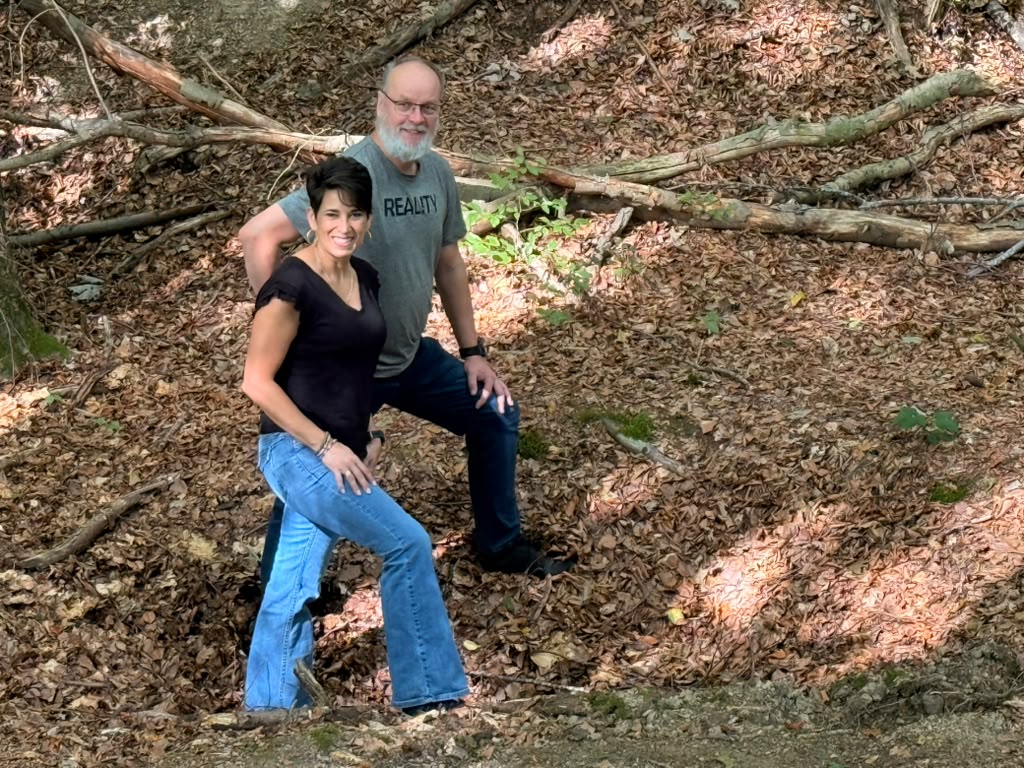
The scars of war are still visible in many places today. Here, we are standing in a former mortar position in vicinity of Bruchhausen.
Drawing on his many years of experience as a career officer, Jürgen was able to answer various military and tactical questions and explain the significance of the terrain for both the American attacks and the German defenses. His professional explanations provided a valuable addition to my military-historical research. Gene also took an active interest in our discussions and repeatedly asked questions about the fighting.
We then visited the military cemetery near Bruchhausen. More than 70 German soldiers who fell during the fighting for the Remagen bridgehead in March 1945 are buried there. We were particularly struck by the graves of several soldiers born in 1927, who had been only 17 or 18 years old when they died. Two civilians also lost their lives during the fighting around Bruchhausen.
From there, our journey continued to Birkig-Berg and the heights overlooking Asberg and Kalenborn. We had now reached the very combat area that had been the central focus of my research. Using the surviving remnants of the former fighting positions and the terrain itself, I was able to show Diane the conditions under which her grandfather and his fellow soldiers had fought in March 1945.
The densely wooded heights, the limited road network, and numerous terrain depressions had made the attacks extremely difficult. Against stubborn German resistance, the American units had repeatedly been forced to fight their way through the woods and across the hills.
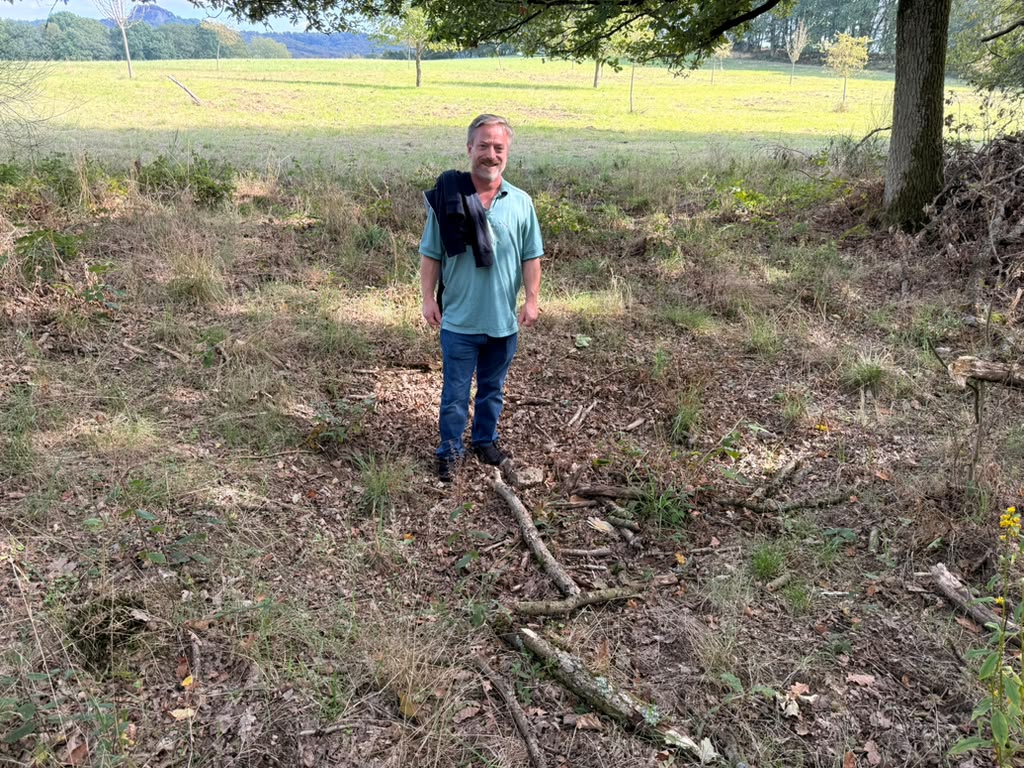
Gene in one of the former positions on Birkig-Berg – once a life-saving shelter, today only recognizable as a shallow depression in the ground.
It was in this sector that particularly heavy and costly fighting developed between 11 and 14 March. The 2nd Battalion, 39th Infantry Regiment, to which Santos belonged, repeatedly attempted to advance from its positions toward Kalenborn. In doing so, it encountered German defensive lines supported by machine guns, mortars, artillery, and individual armored vehicles. While the American battalions struggled to advance through the wooded terrain, German forces repeatedly launched counterattacks in an attempt to contain the penetrations and hold their positions.
For me, it was particularly meaningful to explain the results of my research to Diane while standing in the actual terrain. What can often only be understood from contour lines, tracks, and marked positions on historical maps became visible again in the landscape itself. We could see the distances and terrain conditions for ourselves and gain an understanding of the difficulties the soldiers had faced.
Here, too, Jürgen was able to draw on his military experience to explain various tactical aspects and point out particular features of the terrain.
It was in this combat area, between Steinhübel and Kalenborn, that Santos Ramos Gomez was wounded on 14 March 1945. His exact location at the time and the immediate circumstances of his wounding cannot be determined from the records available so far. What is certain, however, is that G Company and the 2nd Battalion were involved in the heavy fighting toward Kalenborn that day.
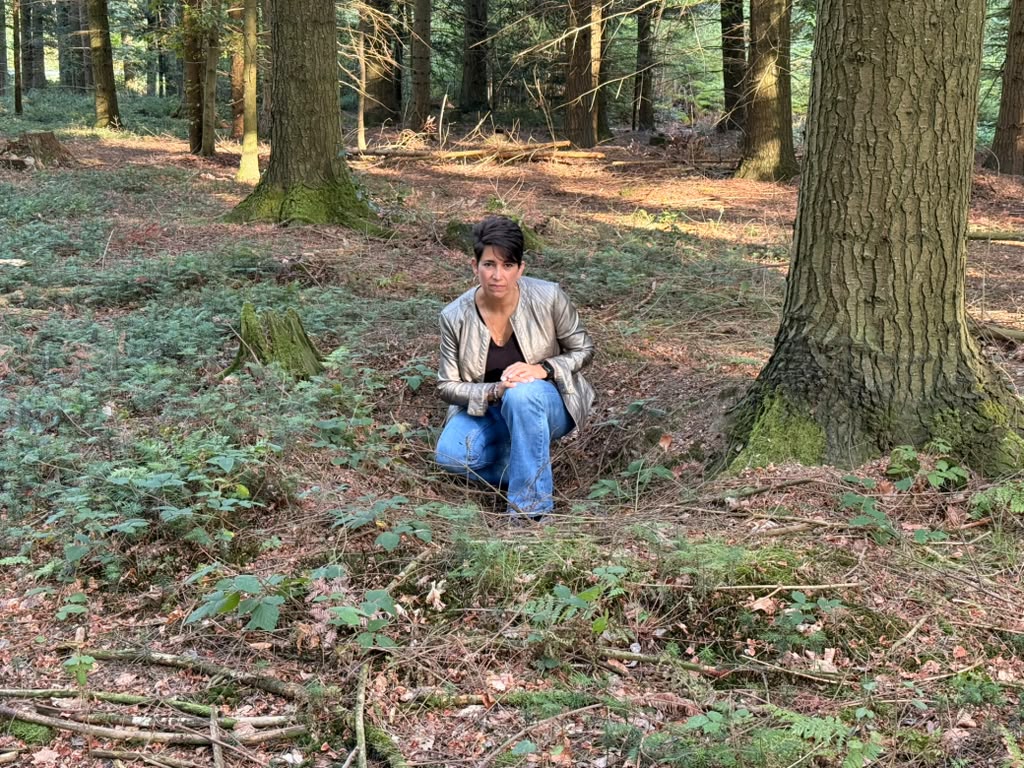
Another former foxhole just outside Kalenborn – one of the forwardmost positions at the time.
For Diane, it was an extraordinary experience to walk in her grandfather’s footsteps more than 80 years later and to discover the places she had previously known only through his stories and my research. Again and again, she expressed how difficult it was to believe that she was really there, walking the same ground her grandfather had crossed so many decades earlier.
As Jürgen had other appointments, he had to leave us after our walk through the former combat area. He was therefore unable to accompany us on our final visit to the Ittenbach military cemetery. Together with Diane, Gene, and Udo, I continued to our last destination.
At Ittenbach, we visited the German military cemetery and explored the history of the former American cemetery that had once stood on the opposite side of the road. The burial ground had been established following the heavy fighting in the Siebengebirge. The first German soldier was buried there on 26 March 1945. During the following days and weeks, the Americans brought additional war dead to Ittenbach from the surrounding battlefields and later from other regions as well.
At one point, approximately 3,600 American soldiers were buried here. In July 1945, the American dead were exhumed and transferred to American military cemeteries, including Margraten in the Netherlands, or repatriated to the United States.
It was here, at Ittenbach, that we finally said goodbye.
After a day spent retracing her grandfather’s combat route from the Rhine crossing to the heights overlooking Kalenborn, our journey had come to an end. However, we agreed that this would not be our last meeting. We intend to stay in touch and continue the friendship that has developed between us.
Diane invited me to visit her if I ever travel to the United States. If that happens, she would like to show me Gettysburg, one of the most famous battlefields of the American Civil War.
For me, this day was far more than a military-historical excursion. My research had developed into a personal encounter with the family of a soldier whose combat route I had previously reconstructed from historical records.
Through Diane’s stories, I learned many things about her grandfather that had never been recorded in any military document. The story of his prayer and his promise, the mistaken death notification, his memories of the bitterly cold winter in Germany, and, not least, his enduring smile added a human dimension to my work that could never have been recovered from war diaries alone.
I also came to understand how closely Santos’s life remains connected to the present. His name lives on through his great-grandson Alexander Santos, and Diane’s commitment to her son adds another chapter to the family’s story.
The moment I presented Diane with my work and the unexpected gift she gave me in return will remain in my memory for a very long time.
I am deeply grateful to Diane for this wonderful day, for her trust, and for allowing me to become a small part of her family’s history and that of her grandfather.
What began as a shared journey in search of the footsteps of an American soldier ended with a friendship across the Atlantic.
And perhaps, one day, that friendship will actually take me to Gettysburg.
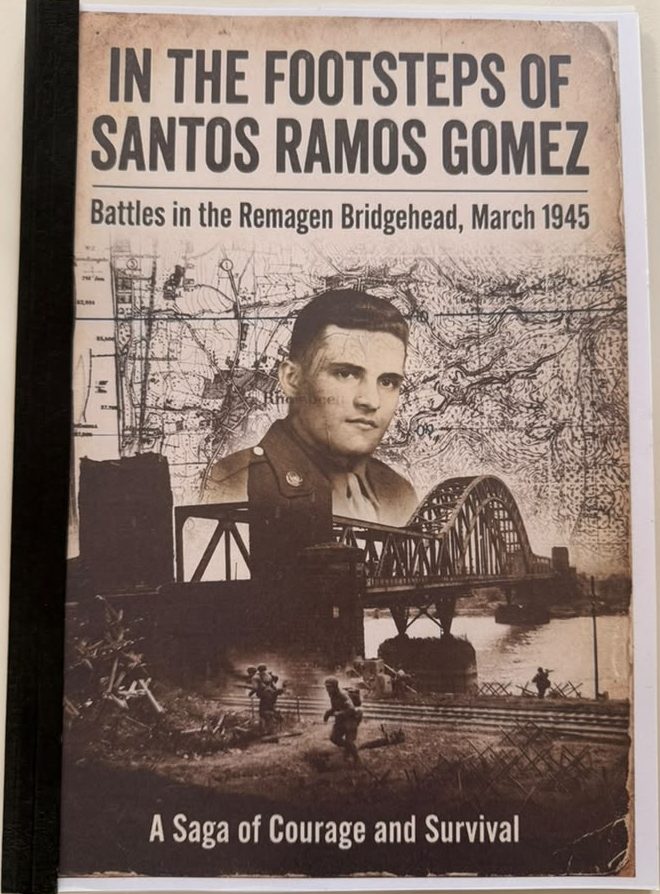
The reconstruction of PFC Santos Ramos Gomez’s route is also an example of one of the main areas of my military-historical work: reconstructing individual soldiers’ histories and combat routes as accurately as possible from the surviving sources.